
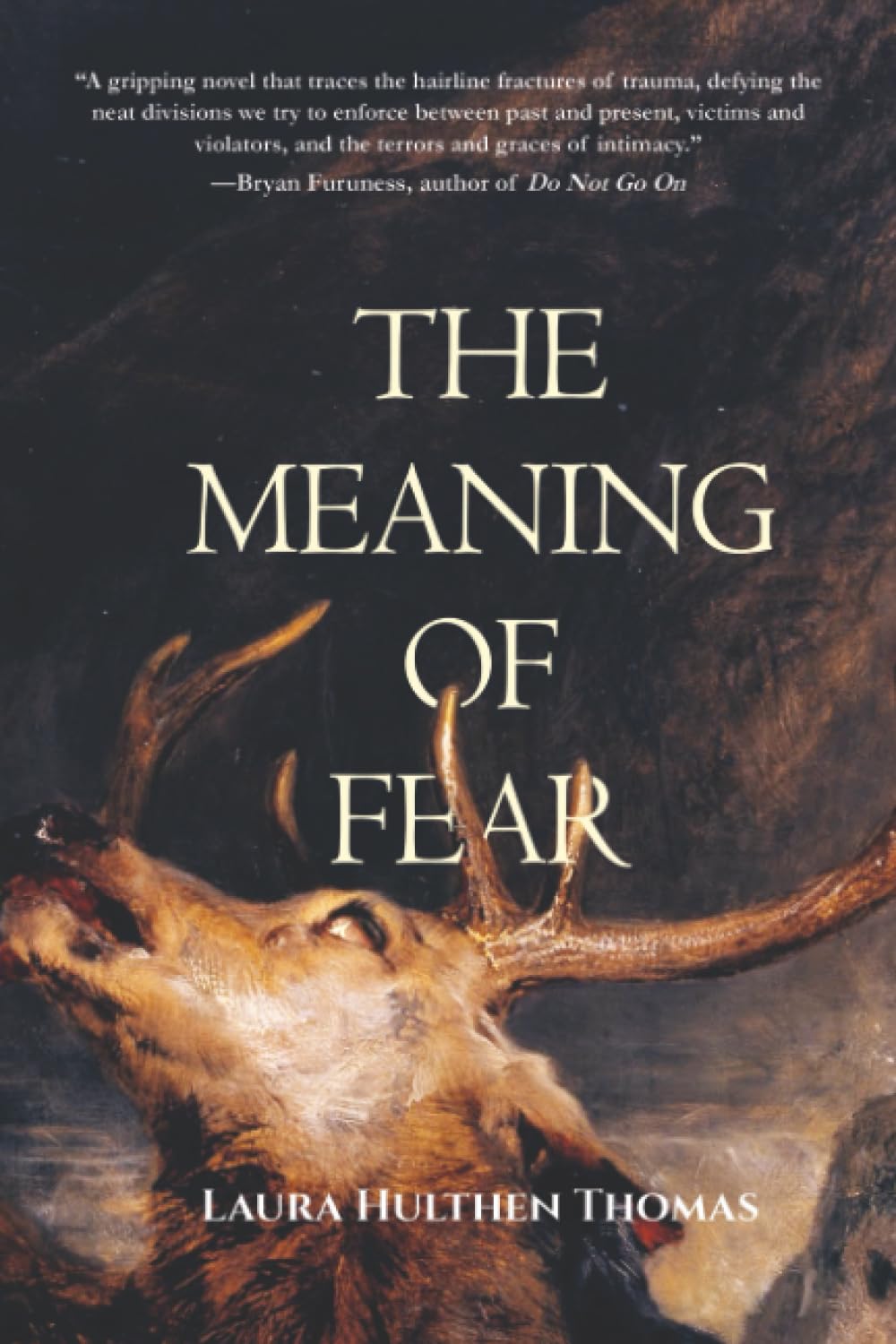
The Meaning of Fear

$20.95
Laura Hulthen Thomas’s The Meaning of Fear is a haunting and intricately layered novel that lingers long after the final page. From its opening scenes, where a young Lea crouches in a driveway, crushing ants while a man from her past reenters her life, the book announces itself as unflinching in its examination of trauma, power, and the distortions of memory.
As a reader and reviewer, I was struck not only by the emotional weight of the story, but by the intelligence and restraint with which Thomas handles such volatile material.
Thomas’s writing style is precise, lyrical, and psychologically astute. She has a remarkable ability to move between past and present without losing clarity, allowing memory to function almost as another character in the novel. The prose is richly textured but never indulgent. Scenes unfold with cinematic detail, such as the gravel driveway, the Mauser rifle above the mantel, and the wildflowers surrounding the beehives, yet the descriptions always serve the emotional stakes. Thomas trusts her readers to sit with ambiguity. She does not sensationalize abuse or fear; instead, she dissects them with the careful eye of a behavioral researcher, mirroring Lea’s own professional lens.
The plot operates on multiple levels: part psychological drama, part mystery, and part meditation on generational trauma. We follow Lea into adulthood as she navigates her marriage, her career, and her unresolved past, while Paul’s narrative offers a parallel exploration of inherited violence and moral reckoning. The suspense builds gradually rather than relying on shock. I appreciated how the novel refuses easy binaries of victim and villain. Characters are shaped by their histories in ways that are both unsettling and deeply human. Thomas invites us to ask whether fear conditions us toward revenge, forgiveness, or something murkier in between.
The characterization is, without question, the novel’s greatest strength. Lea is complicated, brilliant, and painfully real. Her childhood coping mechanisms, control, observation, and emotional compartmentalization, evolve into adult patterns that both empower and isolate her. I am always attentive to how authors portray vulnerability and resilience, and while the novel’s central characters are not framed through racial identity, the emotional truths of surviving harm and navigating systems of power resonate broadly. Lea’s interiority is rendered with such empathy that her contradictions feel earned rather than contrived.
Paul’s chapters add depth and contrast. His upbringing on a struggling farm, his fraught relationship with his father, and his sensitivity toward animals complicate our understanding of masculinity and inheritance. Thomas resists caricature. Even when characters behave destructively, she reveals the formative moments that shaped them. That generosity of vision elevates the novel beyond a simple thriller.
The Meaning of Fear is a bold exploration of how trauma reverberates through time and across relationships. It is both unsettling and compassionate, tense yet thoughtful. Readers who appreciate literary suspense will find this novel deeply rewarding. Thomas has crafted a work that challenges us to confront fear not as a fleeting emotion, but as a force that can define, distort, and, if faced honestly, perhaps transform us.
| Author | Laura Hulthen Thomas |
|---|---|
| Star Count | 4/5 |
| Format | Trade |
| Page Count | 284 pages |
| Publisher | Regal House Publishing |
| Publish Date | 24-Mar-2026 |
| ISBN | 9781646036783 |
| Bookshop.org | Buy this Book |
| Issue | March 2026 |
| Category | Mystery, Crime, Thriller |
| Share |